Beyond the Wellness App: Why Embodied Practice Is Making a Comeback
The wellness app promised calm on demand. For many it delivered one more notification to feel guilty about. A quiet shift is underway back toward practice that happens in a body, in a room, with other people.
For a decade the dominant story about wellbeing was a digital one. Whatever you needed, there was an app for it. Calm was a subscription. Sleep was a soundscape. Presence was a push notification reminding you to be present. The promise was seductive: peace of mind, optimised and available on demand, right there in your pocket.
For some people, some of the time, this genuinely helped. But a growing number are discovering the limits of the model, and the limits are instructive. The very device that delivers the meditation is also the primary source of the agitation the meditation is meant to soothe. Reaching for calm through the same rectangle of glass that fragments your attention all day is a little like trying to sober up with a slightly weaker drink.
There is also a subtler problem. A great deal of wellbeing is not actually an information problem, and apps are information machines. Knowing what you should do to feel calmer is rarely the missing piece. Most people already know. The gap is not knowledge. It is practice, embodiment, and the quiet accountability of doing something real, in a body, often alongside other people.
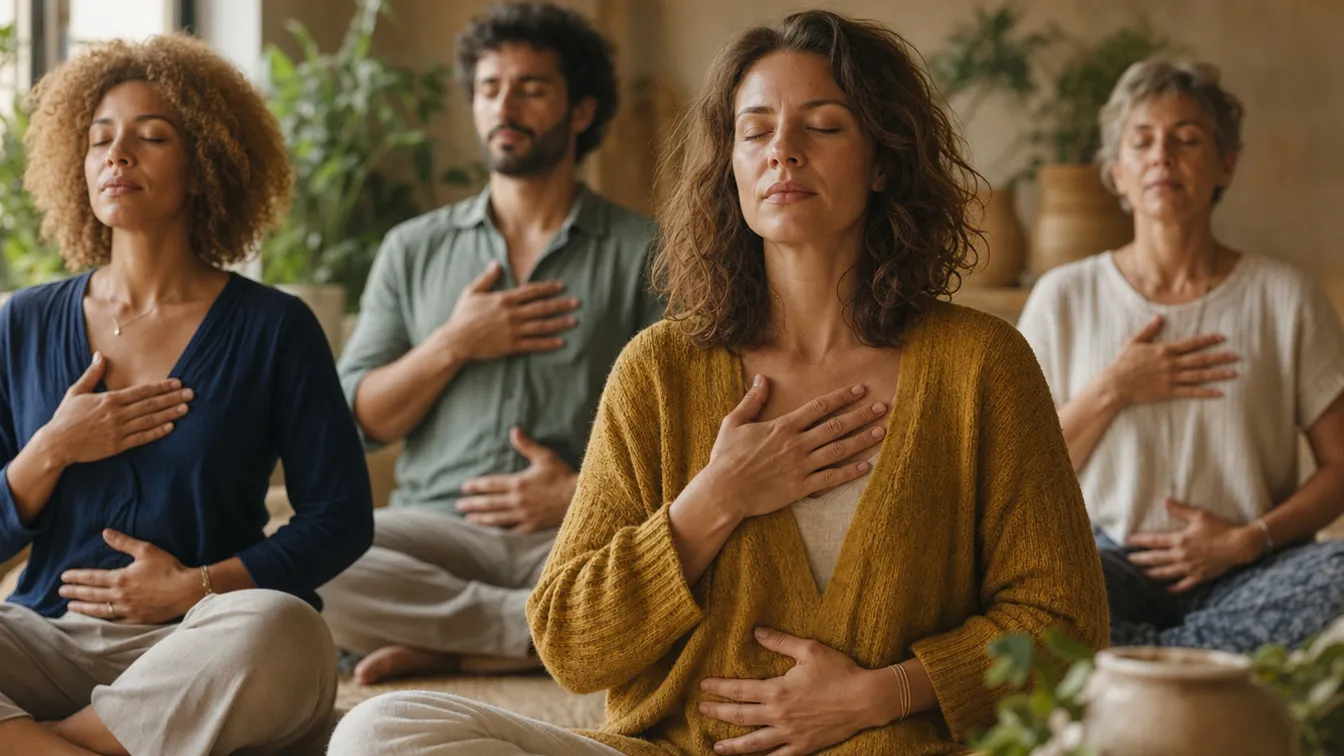
This is why we are seeing a genuine return to embodied practice. Breathwork you do in a room, not through headphones. Conversation circles where the phones are in a basket by the door. Movement, stillness, and communication practised in the physical presence of others who are doing the same. These experiences share something no app can replicate: they take place in three dimensions, in real time, with the full nervous system engaged.
The reason this matters is not nostalgia. It is neurological. So much of what regulates us as human beings is co-regulation, the subtle and largely unconscious way our nervous systems settle in the presence of other calm, attuned people. You cannot download co-regulation. It requires a shared room and a shared moment. A skilled facilitator in a live session is doing something a recording fundamentally cannot: responding to the actual energy of the actual people in front of them.
None of this means technology has no place. A well-timed reminder or a guided audio can be a useful support. The shift is about hierarchy, not rejection. The app was never meant to be the practice. At its best it is a small scaffold around a practice that happens elsewhere, in your body, in your relationships, in rooms where people gather to do the slow and unglamorous work of becoming more present, more resilient, and more genuinely well.
The comeback of embodied practice is, in the end, a rediscovery of something old. That transformation is not a feature to be optimised but an experience to be lived, and that some things worth having simply cannot be delivered through a screen. They have to be practised, in person, together.